Arita-yaki & Craft
Arita-yaki for Hotels: Wholesale Porcelain Procurement (2026)
A B2B guide to Arita-yaki hotel tableware: HTS 6911.10 classification, why the 15% Japan tariff barely moves porcelain duty, custom-glaze lead times and breakage.

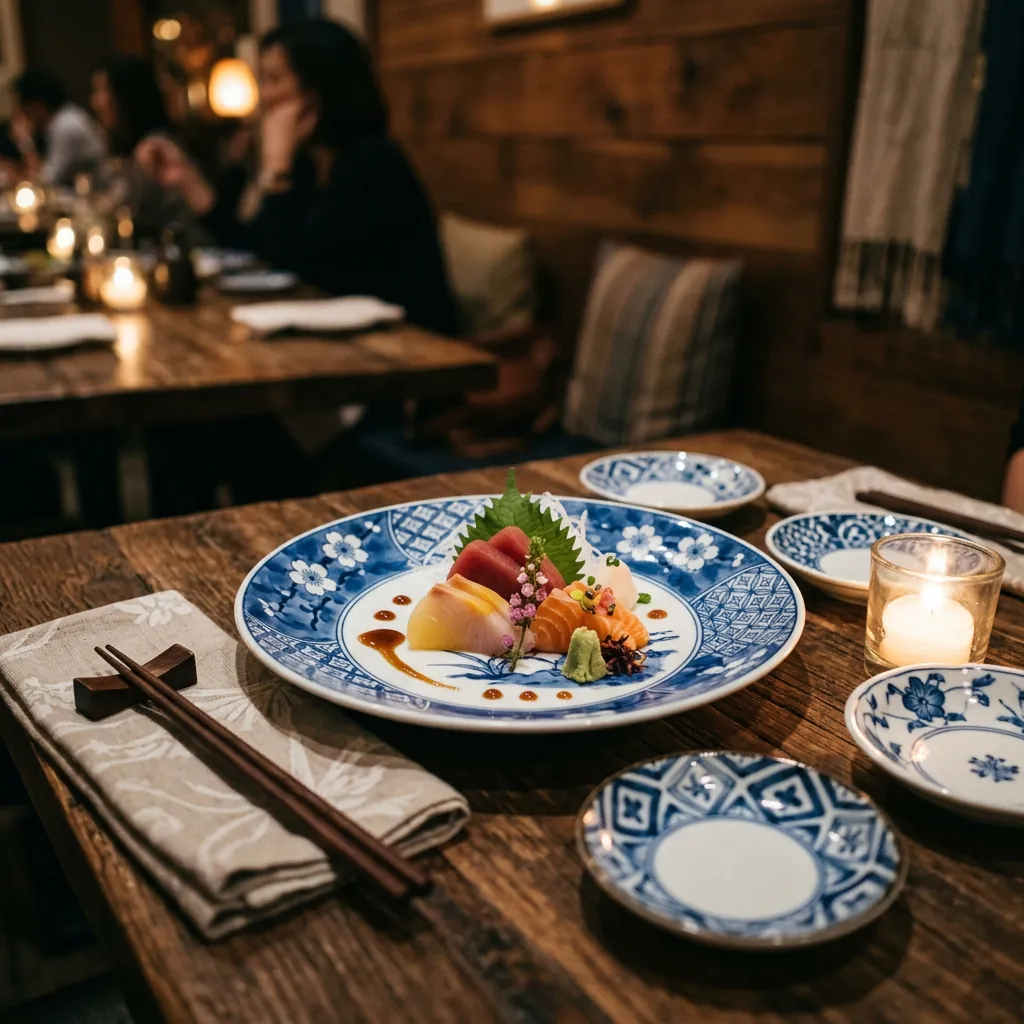
Specifying Arita-yaki hotel tableware is less about choosing a pattern and more about running a procurement process that survives four years of dishwasher cycles, banquet rushes and breakage. The porcelain itself is the easy part — Arita has been firing the hardest, whitest ware in Japan for four centuries. The hard part is classifying it correctly for customs, budgeting realistic custom-glaze lead times, writing an RFQ a Japanese kiln can actually quote against, and planning open-stock continuity so a chipped plate in year two does not strand your whole table setting. This is the briefing I give every hotel F&B and procurement team before their first Arita order.
I source porcelain from kilns in Arita and Imari for hotels, restaurant groups and hospitality designers across the US, UK, EU and the Gulf. Below is how the operational and compliance pieces actually fit together.
What is Arita-yaki, and why does it suit hospitality?
Arita-yaki is the porcelain produced in and around the town of Arita in Saga Prefecture, and it is the oldest porcelain tradition in Japan — production began in 1616, when the Korean potter Yi Sam-pyeong (Ri Sampei, 李参平) found porcelain stone at the Izumiyama quarry and fired Japan's first true porcelain. From around 1650 the Dutch East India Company shipped it to Europe, where it was collected by royalty and directly influenced Meissen and other early European kilns. That four-century pedigree is the story your front-of-house can sell; the material properties are why it belongs in a working kitchen.
Porcelain is vitrified at roughly 1,300°C, which gives it very low porosity, high mechanical strength relative to its weight, and a non-absorbent body that resists staining and odor — exactly what high-turnover service demands. The trade-off is that vitrified bodies are hard but brittle: they survive abrasion and thermal cycling well, but a sharp rim impact chips. That single fact drives most of the procurement decisions later in this guide. The historic styles — Kakiemon overglaze enamel (a designated Important Intangible Cultural Property technique) and the aristocratic Nabeshima style — also tell you that Arita's painters can execute fine custom decoration most volume factories cannot.
How is Arita-yaki classified for US import?
Arita hotel tableware is classified under HTS subheading 6911.10, "tableware and kitchenware, of porcelain or china," and the specific line matters enormously to your duty. The single most important distinction is hotel/restaurant ware versus household ware, because US Customs treats them as different classes of goods with different rates.
Ware sold to hotels and restaurants — i.e., commercial, non-household table and kitchenware — falls under HTS 6911.10.10, "hotel, restaurant and nonhousehold table and kitchenware," reported in dozens of pieces, with a column-1 (general) duty historically around 25%. Household porcelain, by contrast, is split into a thicket of value-based subheadings (6911.10.35, .38, .41, .45, .52, .58 and others) where the rate turns on the declared value per dozen of each article type — cups, plates, mugs, serving pieces. A CBP classification ruling (the principal-use test, sometimes called the Carborundum factors) governs whether your shipment reads as hotelware or household ware, based on how the goods are designed, marketed and sold.
| HTS line | Covers | Reporting unit | Column-1 duty (approx.) |
|---|---|---|---|
| 6911.10.10 | Hotel, restaurant & nonhousehold ware | Dozens of pieces | ~25% |
| 6911.10.35–.45 | Household ware, by article & value band | Dozens of pieces | ~20–26% |
| 6911.10.52–.58 | Household cups/plates over set value thresholds | Dozens of pieces | ~20–26% |
Get the classification wrong and you either overpay duty or invite a CBP reclassification with back-duty and penalties. Confirm your exact line on the USITC Harmonized Tariff Schedule and have your broker request a binding ruling for any borderline SKU. My 2026 tariff overview for wagyu, matcha and nori tracks how the broader Japan tariff framework is moving across categories.
The tariff non-event: why the 15% Japan tariff barely touches porcelain
Here is what most exporters won't tell you, because the tariff headline is easier to sell than the nuance: the 15% reciprocal tariff on Japanese goods does not raise your duty on Arita porcelain at all. Since August 7, 2025, most Japanese-origin goods entering the US carry a 15% reciprocal tariff (implemented by Executive Order 14345), and that surcharge has genuinely repriced sake, incense, tea and many food categories whose base rates sat in the low single digits. But the reciprocal tariff is structured to be inclusive of the normal MFN rate, not stacked on top of it — where a product's existing column-1 rate already exceeds 15%, no additional reciprocal duty applies.
Porcelain hotelware's column-1 rate (~25%) is one of the higher rates in the tariff schedule and already sits well above 15%. So while every Japan importer I talk to is anxious about "the new 15% tariff," the porcelain buyer's landed duty did not move in 2025 — it was already ~25% and stayed there. The practical lesson is to stop watching the tariff headline and start watching your classification and your breakage economics, because those are what actually decide whether your tableware program lands on budget. A factory that quotes you a low FOB price but ships under the wrong HTS line, or a pattern that chips out of open stock in eighteen months, will cost you far more than any reciprocal-tariff line item.
Writing a porcelain RFQ a Japanese kiln can actually quote
A good Arita RFQ specifies function and tolerances, not just a picture, because a kiln cannot price "elegant white plates" but can price a defined article with a defined finish and a defined order quantity. The most common reason a quote comes back slow, vague or expensive is that the buyer sent a mood board instead of a specification. Give the kiln the following and you will get a firm, comparable quote.
Start with the article list with exact dimensions and the per-SKU annual volume — kilns price in firing batches, so a realistic annual figure unlocks better tiered pricing than a tiny first order. State the decoration method (in-glaze versus overglaze, transfer versus hand-painted, single color versus multi-color enamel), because each adds firings and cost. Flag any logo or custom backstamp, which usually needs its own transfer or stamp tooling. Specify your breakage/chip tolerance and edge profile — rolled edges survive service better than thin coupe rims. Require certifications: confirm the ware is lead- and cadmium-safe to FDA limits for food-contact surfaces, and ask for the kiln's test documentation up front. Finally, set the commercial terms — MOQ, lead time, Incoterm, and whether replacement open stock will be held.
When you vet the kiln itself, the same diligence I apply to any Japanese supplier carries over — sample discipline, honest MOQs, lead-time reliability and export-document fluency. I walk through that framework in how to choose a Japanese supplier; the principles translate directly from food to ceramics.
Custom-glaze and custom-shape lead times
Plan Arita lead times in months, not weeks: stock patterns with custom decoration typically run 60–90 days, while fully bespoke shapes with custom glaze and tooling run 90–150 days or more, before ocean transit. Porcelain is made to order in firing batches, and a custom glaze or a new mold adds development cycles — sampling, approval, tooling, then production — that cannot be compressed without risking the result. The table below is the planning baseline I give hospitality clients.
| Scope | What's involved | Typical lead time (pre-shipping) |
|---|---|---|
| Stock pattern, stock shape | Pull from existing kiln catalog | 30–60 days |
| Stock shape, custom decoration/logo | New transfer or backstamp, extra firing | 60–90 days |
| Custom glaze on existing shape | Glaze development + approval samples | 75–120 days |
| Fully bespoke shape + glaze | New mold/tooling, full sampling cycle | 90–150+ days |
Two scheduling realities catch first-time buyers. Arita effectively pauses for the annual Arita Ceramics Fair around the Golden Week holiday (late April to early May), when much of the town's capacity and attention shifts to the fair — build that into any spring timeline. And ocean transit from Kyushu adds several more weeks on top of production. For a property opening, work backward from your FF&E install date and place the porcelain order before almost anything else in the OS&E package.
Breakage allowances and open-stock continuity
The real lifetime cost of hotel porcelain is breakage, not the first order, so a tableware program lives or dies on whether replacement stock stays available and matched. Hotels routinely lose a meaningful share of inventory to chips and breakage every year through normal service and warewashing, and the planning failure is not the loss itself — it is discovering that the pattern has been discontinued, the dye-lot color has drifted, or the kiln's minimum reorder is larger than your replacement need.
Protect continuity with three commitments written into the supply agreement. First, an open-stock guarantee: the kiln agrees to hold or continue your pattern and decoration for a defined term (three to five years is a reasonable ask), so replacements match the originals. Second, a realistic par and reorder model: size the opening order with a built-in spares buffer per SKU based on expected usage intensity and banquet peaks, and set reorder thresholds calibrated to the kiln's lead time — if replacements take 90 days, your reorder point has to sit 90 days of breakage ahead of empty. Third, color/lot control: ask the kiln to record your glaze and enamel references so a reorder two years out still drops into the existing table without a visible mismatch.
One contrarian note from experience: buyers fixate on the thinnest, most delicate coupe shapes because they photograph beautifully, then absorb punishing chip rates in real service. For high-volume outlets I steer clients toward slightly rolled or reinforced rims in the same Arita body and decoration — you keep the provenance and the look on the plate face, and you roughly halve the chip-out rate at the edge where damage actually happens.
Shipping breakable porcelain from Japan
Porcelain ships well when it is packed and consolidated for fragility, and badly when it is treated like any other dry freight, so the logistics decision is part of the product spec. Individual cell-carton or molded-pulp packing, palletized and shrink-wrapped, with full-container (FCL) loading where volume allows, dramatically lowers in-transit breakage versus loose LCL handling where pallets are restacked at consolidation points. For smaller opening orders that don't fill a container, a well-run consolidation with fragility-rated packing is the middle path. I break down the LCL/FCL/air trade-offs for premium and fragile Japanese goods in this logistics guide. Also insure for in-transit breakage explicitly — standard cargo cover often limits or excludes breakage of fragile goods unless you schedule it.
Frequently Asked Questions
What is the import duty on Arita-yaki hotel tableware in 2026?
Porcelain hotel and restaurant ware is classified under HTS 6911.10.10 with a column-1 duty of roughly 25%. The 15% reciprocal tariff on Japanese goods (in effect since August 7, 2025) does not add to this, because it is inclusive of the existing rate and that rate already exceeds 15%. Confirm your exact line and rate on the USITC HTS and with your broker.
Why is hotel porcelain classified differently from household porcelain?
US Customs distinguishes "hotel, restaurant and nonhousehold" ware (HTS 6911.10.10) from household ware, which is broken into value-based subheadings. The principal-use test — how the goods are designed, marketed and sold — determines the class. Misclassifying household-rate goods as hotelware, or vice versa, can trigger reclassification, back-duty and penalties.
How long does custom Arita-yaki take to produce?
Stock patterns with custom decoration typically run 60–90 days; fully bespoke shapes with custom glaze and tooling run 90–150 days or more, before ocean transit. Build in extra time around the annual Arita Ceramics Fair (Golden Week, late April–early May), when much of the town's capacity is committed to the fair.
Is Arita-yaki food-safe and dishwasher-safe for commercial use?
Quality Arita porcelain is vitrified and durable, and most hospitality-grade ware is dishwasher-safe, but you should require lead- and cadmium-release test documentation to FDA food-contact limits, especially for hand-painted overglaze enamels. Ask the kiln for current test results before ordering.
What breakage rate should I plan for, and how do I protect against discontinued patterns?
Plan a realistic annual breakage buffer per SKU based on outlet usage, and negotiate an open-stock guarantee (commonly three to five years) plus glaze/lot color control so replacements match. Set reorder points ahead of the kiln's lead time so you never run out mid-term.
Can a kiln add our hotel's logo or custom backstamp?
Yes. Arita kilns routinely apply custom logos, rim decoration and backstamps via transfer or hand-painting, though a logo usually requires its own tooling and an added firing, which affects both price and lead time. Specify it in the RFQ rather than as a later change order.
This article is general guidance, not legal advice; confirm current requirements with CBP, the USITC HTS, and your customs broker.
Authoritative sources: USITC Harmonized Tariff Schedule · Saga Ceramics Industrial Association — About Arita · CBP Customs Rulings Online (CROSS)
Ready to source from Japan?
Tell us the product, volume and destination. Karen will confirm availability, documents and lead time.