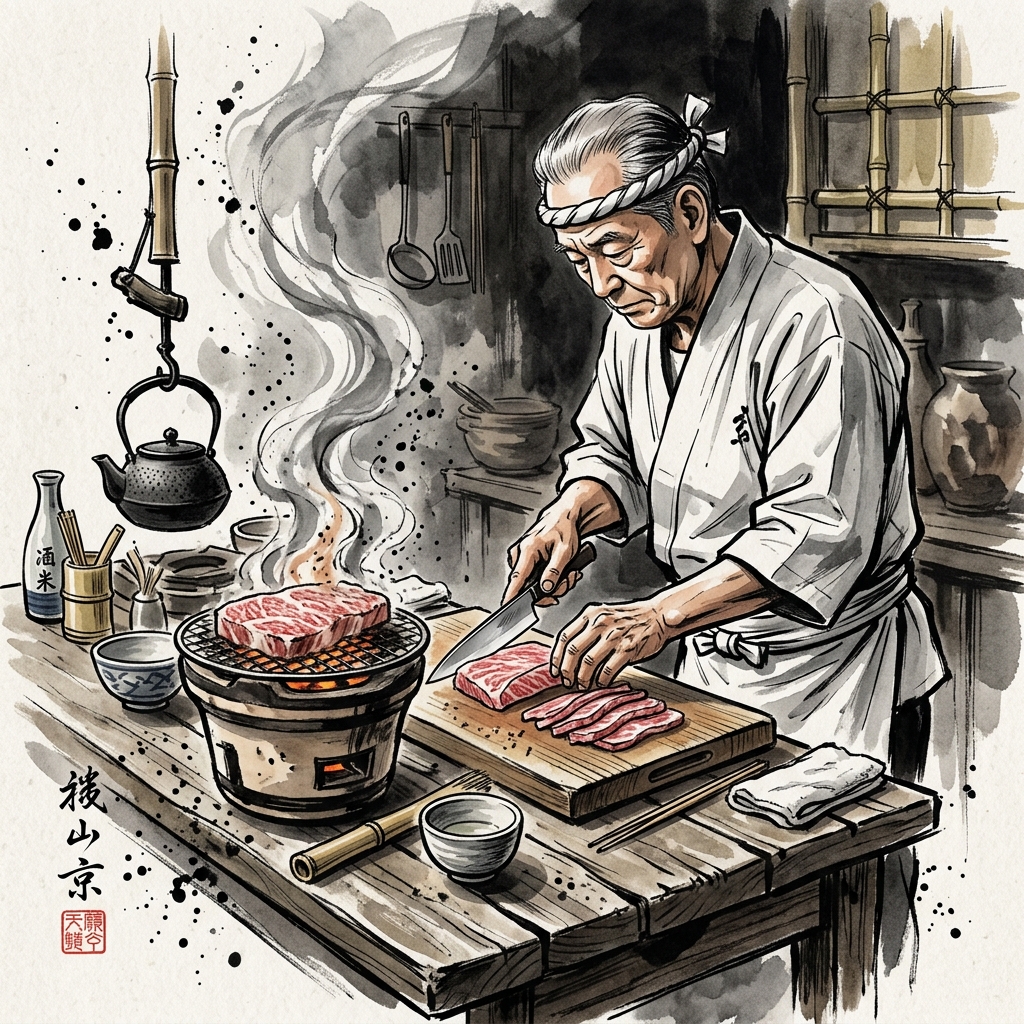
Stage 1: The Livestock Auction
Every wagyu carcass in Japan is sold at one of ~170 livestock auctions nationwide. After grading by JMGA inspectors, the carcass is auctioned to registered meat wholesalers.
| Grade | Typical Auction Price (¥/kg) | 2026 Trend |
|---|---|---|
| A5 (BMS 8-12) | ¥3,200-4,000 | Stable to rising |
| A4 (BMS 5-7) | ¥2,600-3,200 | Stable |
| A3 (BMS 3-4) | ¥2,200-2,800 | Slight decline |
Stage 2: Primal Breakdown
After auction, the carcass is broken into primals. This is where the economics get interesting — a single carcass yields both premium and economy cuts.
| Cut | % of Carcass | Wholesale ¥/kg |
|---|---|---|
| Ribeye | ~8% | ¥18,000-25,000 |
| Striploin | ~7% | ¥15,000-22,000 |
| Tenderloin | ~3% | ¥14,000-20,000 |
| Zabuton | ~4% | ¥8,000-12,000 |
| Chuck/Round | ~40% | ¥3,500-7,000 |
| Trim/Offal | ~15% | ¥1,000-3,000 |
Stage 3: Export FOB Pricing
Export pricing adds 15-25% to wholesale for: processing and portioning, blast freezing, vacuum packaging, JMGA certificates, phytosanitary documentation, and cold chain to port.
Seasonal Price Fluctuations
- December-February: Peak — year-end gift season (お歳暮) drives domestic demand
- March-April: Moderate decline — post-season lull
- May-September: Lowest — summer BBQ creates some demand but supply is steady
- October-November: Rising — autumn festivals and pre-year-end buying begins
Transparent Wagyu Pricing
We provide FOB pricing with full cost breakdown — no hidden markups. Compare our prices against auction data.
Get FOB Price List →FAQ
Why does wagyu price vary so much between suppliers?
Key variables: BMS score, prefecture of origin (Kobe commands premium), cut specificity, and processing level. Always compare like-for-like.
Can I buy wagyu at auction prices?
Not directly as a foreign buyer. Auction access requires Japanese meat wholesale license. Exporters like WAGYU NINJA buy at auction and add processing/export margin.
Is wagyu getting more expensive?
Long-term trend is upward due to declining cattle population in Japan (~1.4M head, down from 1.7M in 2015) and growing export demand.

Karen Hashimoto
Curator & Export Compliance Director · WAGYU NINJA
Karen sources directly from Japanese producers and handles export compliance for B2B buyers in 50+ countries. Based in Fukuoka, Japan. @konnichiwa.karen