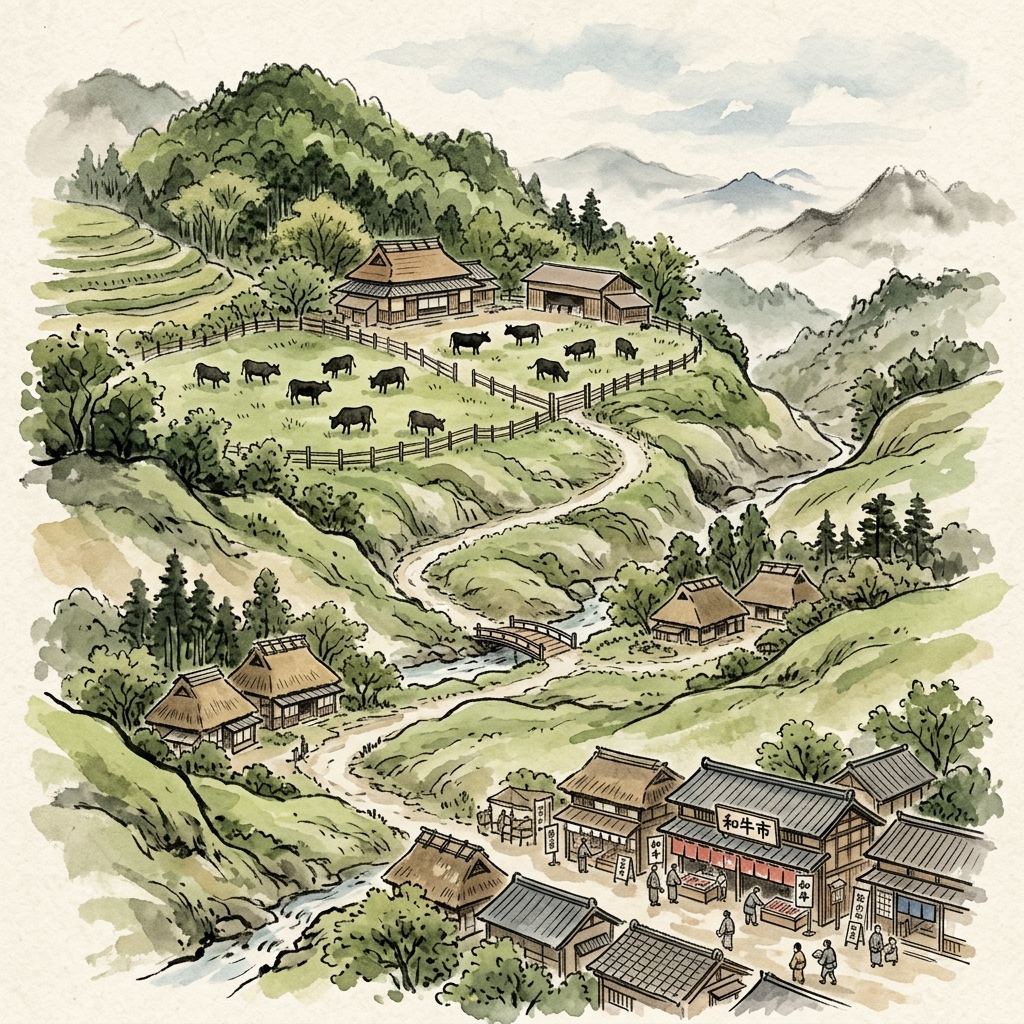
 ## The Journey of Authentic Wagyu
Understanding the Japanese Wagyu supply chain is essential for international buyers looking to import authentic A5 Wagyu. The process is highly regulated, involving multiple specialized entities to ensure unmatched quality and traceability.
### 1. The Breeding Farms (Nshoka)
The journey begins at specialized breeding farms. Calves are raised with extreme care for about 8 to 10 months. Only specific genetic lineages (such as Tajima, Tottori, or Shimane) are selected to ensure high marbling potential.
### 2. The Fattening Farms (Hiku-noka)
At around 10 months of age, calves are sold at auction to fattening farms. Here, they are raised in stress-free environments for another 20 to 24 months. Their diet consists of carefully formulated grains, rice straw, and clear water.
### 3. Slaughter and Grading (Shokuniku Center)
Once they reach ideal weight, the cattle are transported to certified slaughterhouses. After processing, independent graders from the Japan Meat Grading Association (JMGA) evaluate the carcass based on yield and meat quality (marbling, color, firmness, and fat quality). This is where the coveted "A5" rating is awarded.
### 4. Export and Logistics (The Wagyu Ninja Advantage)
Exporting chilled Wagyu requires a flawless cold chain. Wagyu Ninja acts as the critical bridge in this step. We source directly from the slaughterhouses and regional auctions, handle all export documentation (including health certificates and FDA compliance), and utilize advanced air-freight cold chain logistics to deliver pristine Wagyu to your restaurant or distribution center worldwide.
## The Journey of Authentic Wagyu
Understanding the Japanese Wagyu supply chain is essential for international buyers looking to import authentic A5 Wagyu. The process is highly regulated, involving multiple specialized entities to ensure unmatched quality and traceability.
### 1. The Breeding Farms (Nshoka)
The journey begins at specialized breeding farms. Calves are raised with extreme care for about 8 to 10 months. Only specific genetic lineages (such as Tajima, Tottori, or Shimane) are selected to ensure high marbling potential.
### 2. The Fattening Farms (Hiku-noka)
At around 10 months of age, calves are sold at auction to fattening farms. Here, they are raised in stress-free environments for another 20 to 24 months. Their diet consists of carefully formulated grains, rice straw, and clear water.
### 3. Slaughter and Grading (Shokuniku Center)
Once they reach ideal weight, the cattle are transported to certified slaughterhouses. After processing, independent graders from the Japan Meat Grading Association (JMGA) evaluate the carcass based on yield and meat quality (marbling, color, firmness, and fat quality). This is where the coveted "A5" rating is awarded.
### 4. Export and Logistics (The Wagyu Ninja Advantage)
Exporting chilled Wagyu requires a flawless cold chain. Wagyu Ninja acts as the critical bridge in this step. We source directly from the slaughterhouses and regional auctions, handle all export documentation (including health certificates and FDA compliance), and utilize advanced air-freight cold chain logistics to deliver pristine Wagyu to your restaurant or distribution center worldwide.

Karen Hashimoto
Curator & Export Compliance Director · WAGYU NINJA
Karen sources directly from Japanese producers and handles export compliance for B2B buyers in 50+ countries. Based in Fukuoka, Japan. @konnichiwa.karen