Shiitake
How to Import Japanese Dried Shiitake to the EU: Phytosanitary, Mycotoxins & Wholesale Specs (2026)
Complete B2B guide to importing Japanese dried shiitake into the EU — Donko vs Koshin grades, HS code 0712.34, JEFTA tariff treatment, EU 2023/915 cadmium and lead limits, phytosanitary certificates, and wholesale MOQs from Oita producers.
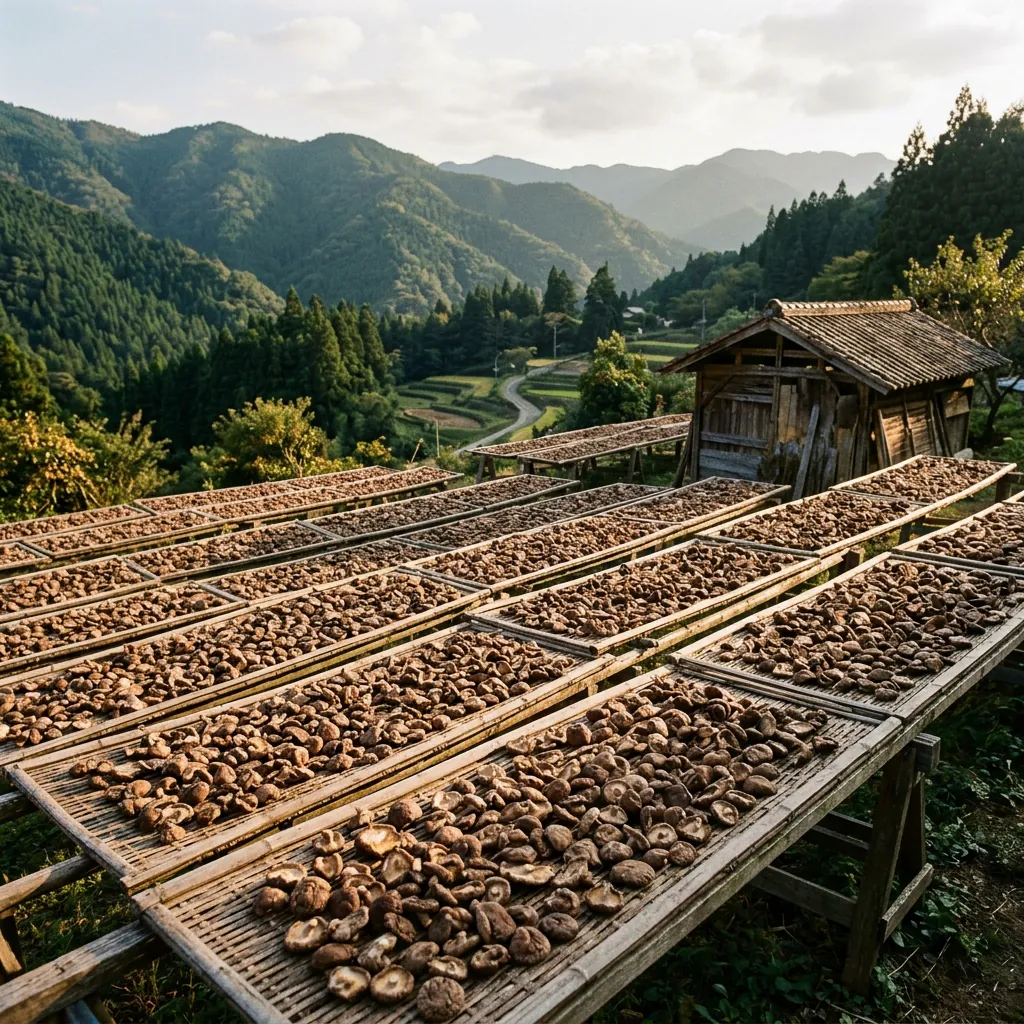
I get a version of this email every other week, almost always from a Berlin importer or a Paris-based specialty grocer: "We tried Chinese dried shiitake. It rehydrates strangely and the umami is flat. Can you source the real Japanese ones, and what do we need to clear EU customs?" The product they want is Japanese log-grown Donko (donko shiitake, 冬菇). The compliance answer is more technical than most buyers expect, and the customs classification is the single most common place importers lose money — usually because they file under the wrong HS code.
This is the guide I wish existed when I first started sourcing Oita dried shiitake for EU buyers in 2022.
Why EU Buyers Source Dried Shiitake from Japan, Not China
Japanese dried shiitake is a fundamentally different product from the high-volume Chinese commodity grade, and the price gap reflects that. The most important variable is cultivation method: roughly 90% of Japan's dried shiitake is grown on natural hardwood logs (genboku saibai, 原木栽培) — usually konara and kunugi oak — rather than on sterilized sawdust blocks. Log-grown shiitake develops thicker, denser caps with more concentrated guanylate (the umami nucleotide), and according to MAFF data, about 70% of Japan's dried shiitake comes from just three prefectures: Oita, Miyazaki, and Kumamoto — all in Kyushu, where the climate cycles between cool nights and warm springs that favor slow cap development.
Spring-harvest Donko (haru-ko, 春子) is the prize. Lower harvest-time temperatures produce thicker flesh, and roughly 80% of the annual log-grown crop is harvested in spring rather than autumn. If a Chinese supplier quotes "log-grown Donko" at €18/kg FOB Shanghai, you're almost certainly being sold sawdust-grown product with a misleading label. Authentic Oita spring-harvest Donko at wholesale typically lands between €55 and €110/kg FOB Fukuoka, depending on cap diameter and the percentage of Hana-donko (flower-cap, the crackled-surface premium grade) in the lot.
I always tell new buyers: shiitake price compresses everything about the cultivation method, prefecture, harvest season, and cap size into a single number. If a quote looks suspiciously cheap, one of those four variables is being cheated.
Donko vs Koshin: What Grade Are You Actually Buying?
Under Japan's MAFF Shiitake Quality Labeling Standards (椎茸品質表示基準), dried shiitake is graded primarily on cap-opening at harvest. Donko (冬菇) is harvested with the cap less than 70% open — thick, meaty, expensive. Koshin (香信) is harvested after the cap fully opens — thinner, larger, easier to slice, and significantly cheaper. Between them sits Koko (香菇), a 70–80%-open intermediate.
| Grade | Cap state at harvest | Typical cap diameter | Best use case | Wholesale price band (FOB) |
|---|---|---|---|---|
| Hana-donko (花冬菇) | <60% open, crackled white surface | 4–7 cm | Fine dining, gift sets, photography-grade plating | €120–€220/kg |
| Donko (冬菇) | <70% open | 3–5 cm | Restaurants, dashi base, premium retail | €55–€110/kg |
| Koko (香菇) | 70–80% open | 4–6 cm | Mid-tier retail, food service | €30–€55/kg |
| Koshin (香信) | Fully open | 5–9 cm | Sliced applications, soup mixes, ramen toppings | €18–€35/kg |
| Sliced/julienne (スライス) | Pre-cut Koshin | — | Instant rehydration products, RTD soups | €22–€40/kg |
A piece of buyer-side advice I rarely see written down: for most restaurant and retail applications, Koko offers the best price-to-quality ratio — you get most of the textural integrity of Donko at roughly half the cost. Donko is worth the premium only when whole, intact caps appear on the plate. If the mushrooms will be sliced, simmered, or ground, Koshin or Koko will outperform Donko on cost without a meaningful flavor penalty.
EU Regulatory Framework: What You Must Comply With
There are three regulatory layers for dried shiitake entering the EU: phytosanitary, contaminant limits, and general food law. None of them is optional.
1. Phytosanitary certificate (MAFF Plant Protection Station)
Dried shiitake is a plant-origin product, so each EU-bound shipment requires a phytosanitary certificate issued by Japan's MAFF Plant Protection Station (Shokubutsu Boekisho, 植物防疫所). Inspection happens at the export warehouse before container loading. The certificate confirms the product is free of regulated pests (notably Trogoderma granarium and certain stored-product moths) and is the document your EU customs broker will demand at entry. No phytosanitary cert = no clearance. I've seen shipments held at Rotterdam for over a week because a producer forgot to apply 48 hours in advance.
2. Contaminant limits under Commission Regulation (EU) 2023/915
The consolidated EU contaminants regulation, Commission Regulation (EU) 2023/915, sets species-specific maximum levels for heavy metals in mushrooms. For Lentinula edodes (shiitake), the limits are:
- Cadmium: 0.15 mg/kg (vs 0.050 mg/kg for cultivated Agaricus mushrooms)
- Lead: 0.30 mg/kg
These limits apply on a fresh-weight equivalent — for dried product, the dehydration factor (typically ~10x for shiitake reaching <9% moisture) means your dried-basis values need to be divided by the dehydration factor when assessed. Reputable Oita producers issue Certificates of Analysis from accredited labs with each lot; never accept a shipment without one. Soil-grown log shiitake from Kyushu volcanic terroir generally tests well below the limit, but it's the lot-specific CoA that matters at the EU border, not the producer's reputation.
3. General Food Law and traceability
Regulation (EC) 178/2002 (General Food Law) requires one-step-back / one-step-forward traceability. Your EU import file should carry the producer's farm registration number, harvest date, drying batch ID, and lot number all the way through to retail. For private-label work, this also affects your country-of-origin labeling: under EU rules, "Produce of Japan" must reflect the country where the mushroom was cultivated, not packed.
Sourcing tip: if you're planning to private-label, ask the producer for the cooperative slip (組合伝票) showing the log inoculation date. That document is the single hardest thing for a non-Japanese supplier to fake — and EU enforcement officers know to ask for it.
HS Code 0712.34: The JEFTA Tariff Advantage Most Importers Miss
Here is the single most expensive mistake I see in EU import filings: dried shiitake is filed under HS heading 0712.39 (other dried mushrooms). It almost always should be filed under HS 0712.34, which is the dedicated subheading for dried shiitake (Lentinus edodes / Lentinula edodes). The two codes carry different EU MFN tariff treatments, and — critically for Japan-origin shipments — different JEFTA outcomes.
Under the EU-Japan Economic Partnership Agreement (in force February 2019), dried shiitake under 0712.34 entered into immediate duty elimination on the EU side. With a valid statement on origin from a Japan-registered exporter (REX number), your shipment enters the EU duty-free. File under 0712.39 by mistake and you're either misclassified (a customs penalty) or paying MFN duty unnecessarily.
| HS code | Coverage | EU MFN tariff (illustrative) | JEFTA preferential treatment |
|---|---|---|---|
| 0712.31 | Dried Agaricus mushrooms | ~12.8% + tariff quota | Reduced / liberalised |
| 0712.32 | Wood ears (Auricularia) | ~12.8% | Reduced |
| 0712.33 | Jelly fungi (Tremella) | ~12.8% | Eliminated |
| 0712.34 | Dried shiitake (Lentinula edodes) | ~12.8% | Eliminated (duty-free with origin) |
| 0712.39 | Other dried mushrooms (excluding shiitake & above) | ~12.8% | Eliminated |
Always confirm current rates with the EU Access2Markets database before filing — tariff codes are reviewed periodically — but the classification rule (0712.34 = shiitake specifically) is stable. If you're working with an internal pillar piece on Japanese food tariffs, our Japan food import tariffs 2026 overview walks through the broader rate structure.
Wholesale Specs: What to Put in Your Purchase Order
A clean PO for Japanese dried shiitake should pin down seven things. Vague POs are where Japanese producers (who culturally avoid pushing back) silently default to whatever's easiest for them, and you end up with a mismatched shipment.
- Cultivation method: must specify genboku (原木 / log-grown), not kinshou (菌床 / sawdust).
- Prefecture of origin: Oita / Miyazaki / Kumamoto are the benchmark trio. Specify single-origin if branding requires it.
- Harvest season: spring (haru-ko, March–May) vs autumn (aki-ko, September–November). Spring is denser; autumn is more aromatic.
- Grade: Hana-donko / Donko / Koko / Koshin (see grade table above).
- Cap diameter range: e.g., 25–42 mm for medium Donko, 42–55 mm for large.
- Moisture: ≤ 9% for premium grade. The general food trade tolerates up to 13%, but anything above 11% is a quality red flag — it shortens shelf life and risks mold.
- Packaging: standard is 5 kg or 10 kg double-PE-lined craft cartons with oxygen absorber, vacuum-packed for export. Confirm dimensions and gross weight so your freight forwarder can palletize accurately.
Typical MOQs for direct-from-Oita sourcing run 6 kg (mixed-grade sample lot) to 60 kg (single-grade, single-origin lot). Larger volumes (200 kg+) are negotiated against a producer's pre-auction allocation and require commitment 3–6 months ahead of the spring harvest.
Shipping & Lead Times: Sea vs Air for Dried Shiitake
Dried shiitake is shelf-stable, low-density, and not temperature-critical — which makes it one of the few premium Japanese products where sea freight is genuinely fine. The economics shift sharply against air freight at almost any volume.
| Mode | Transit (Japan → EU) | Cost band per kg | When to use |
|---|---|---|---|
| Air (Kansai → FRA/AMS) | 2–4 days | €4.50–€7.00/kg + handling | Sample orders, premium gift-pack launches, time-critical promo |
| LCL sea (Yokohama → Rotterdam/Hamburg) | 35–45 days door-to-door | €1.20–€2.20/kg | 50–300 kg orders, repeat replenishment |
| FCL sea (20'/40' container) | 30–40 days | €0.40–€0.90/kg | 2 tonnes+ commitments, brand-volume buyers |
For most EU specialty importers, a rolling LCL programme — 100–200 kg every 4–6 weeks — gives the best balance of cash-flow, freshness, and unit economics. Pair it with vacuum-packed cartons inside an oxygen-controlled master case and you'll preserve full umami concentration for 18 months. For a deeper comparison across our product range, see our LCL vs FCL vs air freight breakdown.
The Contrarian Insight: "Japan-Origin" Labels in the EU Aren't What You Think
Here is something I almost never see written down by Japan-side exporters, and it costs EU buyers margin every year. A substantial volume of "Japanese dried shiitake" on EU shelves was grown on Chinese sawdust blocks, finished (dried and packaged) in Japan, and labeled "Produce of Japan" under origin rules that legacy importers exploit. EU origin rules under the Union Customs Code generally require that the last substantial transformation occurs in the claimed country — and drying alone is contested ground.
If you want genuine log-grown Oita Donko, the safest verification is the Oita Forest Products Cooperative slip (大分県産椎茸生産農協 / Oita-ken-san shiitake seisan nokyo) accompanying the shipment. That document references the log inoculation date and the farm code. Without it, you cannot definitively prove log-grown Japanese origin even if the packaging says so. I tell my EU clients: pay €5–€8/kg more for the documented log-grown product, because the price-per-actual-umami is dramatically better — and your customers will taste the difference within two weeks of switching.
Frequently Asked Questions
What is the shelf life of Japanese dried shiitake for wholesale buyers?
Properly vacuum-packed Japanese dried shiitake at <9% moisture has an 18–24 month shelf life when stored below 20°C and away from direct light. Once a master case is opened for retail repacking, expect 6–9 months at consumer-grade airtight packaging.
Do I need FDA registration if I'm shipping through a US port to the EU?
No — FDA jurisdiction only applies if the product enters US commerce. Pure trans-shipment in bond does not require FDA Prior Notice. However, you must hold the EU import documentation (phytosanitary, CoA, REX origin statement) for clearance at the EU port.
What is the minimum order quantity for Japanese dried shiitake?
Direct-from-farm sourcing typically starts at 6 kg for mixed-grade sample lots and 60 kg for a single-grade, single-origin lot. Pre-auction commitments for spring-harvest Donko (200 kg+) require 3–6 month lead time. Trading-house intermediaries will quote lower MOQs but at significantly higher unit cost.
Is organic certification (JAS, EU Organic) available for log-grown Japanese shiitake?
Yes, but availability is limited. Log-grown shiitake is naturally low-input, but JAS Organic certification adds approximately ¥150,000–¥300,000/year per producer in audit costs, so only larger Oita cooperatives carry it. EU Organic (Regulation 2018/848) is recognized under the EU-Japan equivalency for processed plant products; budget 3–5% on top of standard wholesale pricing for certified lots.
Can I private-label Japanese dried shiitake for my retail brand?
Yes. Most Oita producers offer private-label packing in 10g, 20g, 50g, 100g, and 250g consumer units with custom box printing. Typical MOQ for printed packaging is 1,000–3,000 units per SKU, with 8–12 week lead time including artwork approval and packaging production.
How does Japanese dried shiitake compare to Korean or Chinese log-grown shiitake?
Korean log-grown shiitake (also called bakgo) is genuinely high quality and roughly 25–35% cheaper than Japanese equivalents. The flavor profile is slightly less complex but acceptable for most cooking applications. Chinese log-grown shiitake is rare on the international market — the vast majority of Chinese export-grade shiitake is sawdust-cultivated, regardless of label claims.
Ready to source from Japan?
Tell us the product, volume and destination. Karen will confirm availability, documents and lead time.